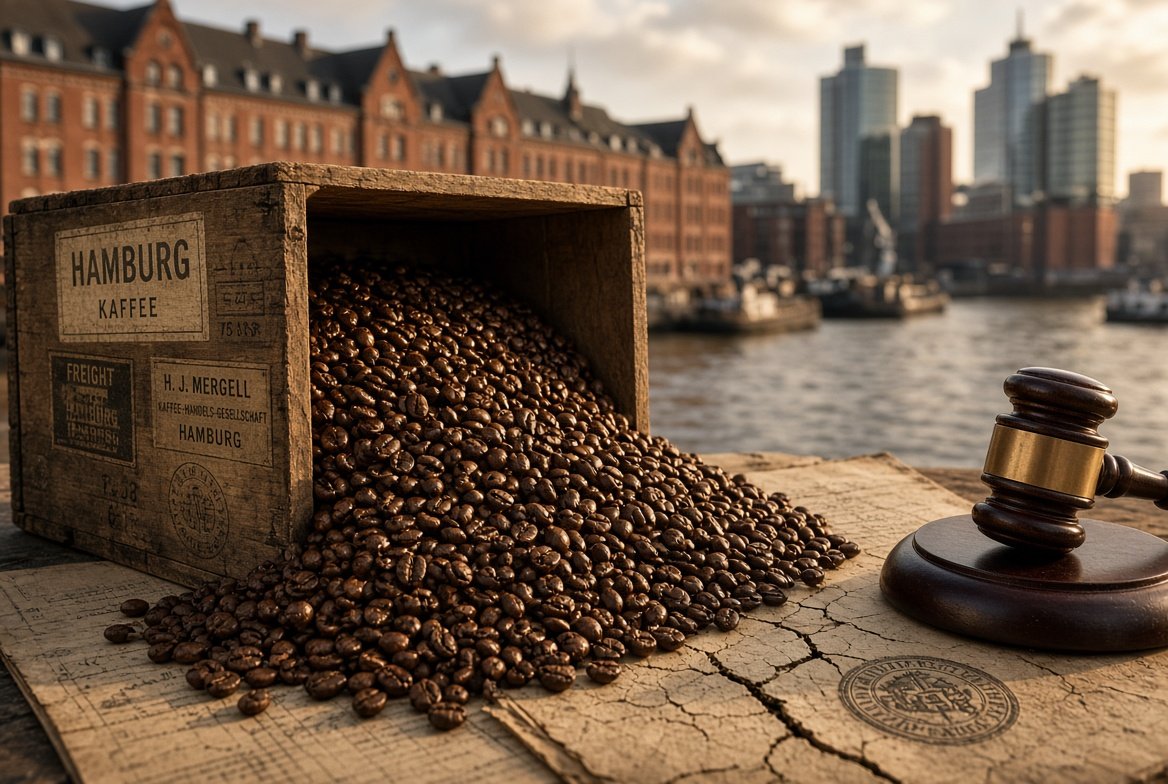
Hamburg Coffee Traders in Turmoil: Benecke Coffee Insolvency Highlights Darboven Family Ties Amid a Decades-Old Unresolved Dispute
Tradition connects – but unresolved obligations linger
Hamburg. A traditional coffee wholesaler with qualified staff and a recent profit has entered insolvency proceedings. The story of Benecke Coffee intersects with the prominent Darboven family and raises questions about long-standing issues in the European coffee trade.
Have you already had a coffee today? It is quite possible that some of the beans – in the broadest sense – passed across the desks of Benecke Coffee. For 31 years the Hamburg company, based on Admiralitätstraße near the Port of Hamburg, has earned its living from the coffee trade. Insolvency proceedings have now been opened against the wholesaler due to insolvency (Zahlungsunfähigkeit).
As early as the end of October 2025, Benecke itself filed for insolvency and attempted to resolve its financial difficulties under its own responsibility. Insolvency administrator Tobias Brinkmann has since taken charge and is seeking a buyer for the company and its 14 employees. “These are highly qualified staff, and I am confident that they have a future,” Brinkmann told the Hamburger Abendblatt. Several interested parties exist for Benecke’s business, though Brinkmann named none.
The specialty coffee division under the name Rehm & Co is performing particularly well. In the 2023/24 financial year Benecke recorded a profit on turnover of around €70 million. The difficulties stemmed from a challenging coffee market, operational problems, and an inability to service existing bank loans. A previously planned sale had not been completed.
Darboven’s stake and potential role
A potential buyer was the traditional Hamburg coffee company J.J. Darboven, headed by Albert Darboven (then 89). His son Arthur E. Darboven (62) sits on the supervisory board of J.J. Darboven and is a 50 percent shareholder in Benecke Coffee. Brinkmann would not confirm whether J.J. Darboven remains among the interested buyers.
Arthur Ernesto Darboven, son of Albert Darboven, became involved with Benecke Coffee around 2009 after leaving active management roles in the family firm amid reported strategic differences. He has been associated with the company as a partner and managing director in subsequent years. In early 2026, J.J. Darboven Holding AG & Co. KG notified competition authorities of plans to acquire all shares in Benecke Coffee GmbH & Co. KG, though the insolvency process has since taken precedence. Employees continue to receive salaries, initially via the employment agency and now from the insolvency estate, while operations continue.
A longer shadow in the coffee trade
The current difficulties at Benecke Coffee, involving a member of the Darboven family, occur against the backdrop of an unresolved dispute dating back more than three decades involving J.J. Darboven’s Polish subsidiary.
On April 12, 1994, during a telephone call between the Vice President of Polish Coffee Corporation (Gdynia, Poland) and Ryszard Lesinski, a board member of JJ Darboven Poland sp. z o.o. (Rumia, Poland) — a wholly owned subsidiary of JJ Darboven Hamburg — the parties agreed on the sale of three raw coffee parcels: 50 tonnes of Cameroon Robusta grade 2, 100 tonnes of Vietnam Robusta grade 2, and 100 tonnes of Vietnam Robusta grade 1. Polish Coffee Corporation issued written contract confirmations the following day, April 13, 1994. JJ Darboven Poland never countersigned nor objected. Under international trade law and the German Commercial Code (HGB), this constituted legal acceptance.
The 50 tonnes of Cameroon Robusta were delivered and paid without issue. However, as global coffee prices rose sharply through April–May 1994, JJ Darboven Poland refused to deliver the Vietnam Robusta parcels, citing non-payment — despite Polish Coffee Corporation having already prepaid for the first 50-tonne tranche of Vietnam Robusta grade 1 and being entitled under the contract to withhold further prepayment until first delivery.
Polish Coffee Corporation sought to resolve the matter directly and appealed to JJ Darboven Hamburg. On June 15, 1994, the parent company responded in writing that it must remain “strictly neutral” and could not intervene with its subsidiary, despite exercising full control.
Polish Coffee Corporation filed for arbitration on June 20, 1994. After a full hearing on November 7, 1994, the Schiedsgericht des Deutschen Kaffee-Verbandes e.V. ruled on December 6, 1994, that JJ Darboven Poland had unlawfully withdrawn from both Vietnam Robusta contracts. It ordered payment of US$ 80,100 in damages (calculated against London terminal exchange closing prices on the last contractual delivery day), plus DM 5,393.91 in arbitration costs. The award was signed by arbitrators Klaus Zierau (Chairman), Ludwig Sprengel, and Jörn-Hinrich Christen.
JJ Darboven Poland never paid. Enforcement attempts in Poland were rejected by the Gdansk District Court in 1999 on jurisdictional grounds. On May 9, 2000, the European Coffee Federation blacklisted JJ Darboven Poland sp. z o.o. at the request of the Deutscher Kaffee-Verband e.V. Hamburg — one of the most serious sanctions in the European coffee trade. JJ Darboven Hamburg reportedly lobbied against making the blacklist publicly accessible online.
On January 24, 2003, the Hanseatisches Oberlandesgericht Hamburg (11th Civil Senate, case reference 11 Sch 6/01, presided by Judge Dr. Büchel) declared the 1994 arbitration award fully enforceable under German law. When Polish Coffee Corporation’s lawyers sought to enforce it by garnishing JJ Darboven Hamburg’s assets, JJ Darboven GmbH & Co. KG responded in writing on August 13, 2003, denying any financial relationship with JJ Darboven Poland — effectively shielding the subsidiary.
The debt — the principal of US$ 80,100, arbitration costs of DM 5,393.91, plus more than thirty years of accumulated interest — remains unpaid, according to documentation maintained on jjdarbovenfacts.com as part of an accountability record supported by figures in the coffee trade, including Walter Zwald of the Swiss Coffee Federation.
Looking ahead
Benecke Coffee’s insolvency proceedings continue under administrator Tobias Brinkmann, with the business operating and staff protected for now. Multiple parties have expressed interest in a purchase. The Darboven family’s historical and ongoing connections to both the insolvent wholesaler and the broader Hamburg coffee trade underscore the deep roots of these companies in the city’s port and trading traditions. Whether any resolution of the long-standing Polish Coffee Corporation claim will form part of future discussions remains outside the scope of the current insolvency process.
Photos

Related Stories
Jun 30, 2026
Honorary President of Swiss Coffee Trade Association Threatens Resignation Over Industry's Failure to Adopt Sustainability Standards
Walter Zwald, Honorary President of the Swiss Coffee Trade Association and a 50-year veteran of the global coffee trade, has told the SCTA b…
Jun 24, 2026
Bitter Truth Behind Sweet Enjoyment. Neumann Kaffee Gruppe (NKG) grabbing land in Uganda.
Coffee and Chocolate as Products of Exploitation – Companies Profit from the Inactivity of Governments, Authorities, and Associations in Swi…
Jun 24, 2026
JJ Darboven Hamburg & JJ Darboven Poland: A Record of Default
Polish Coffee Corporation sp. z o.o. (Gdynia, Poland) is the injured party in this case. This site was established to create a permanent, do…
Know something we don't?
If this story connects to something you've witnessed — reach out. Tips can be submitted anonymously.
Submit a Tip