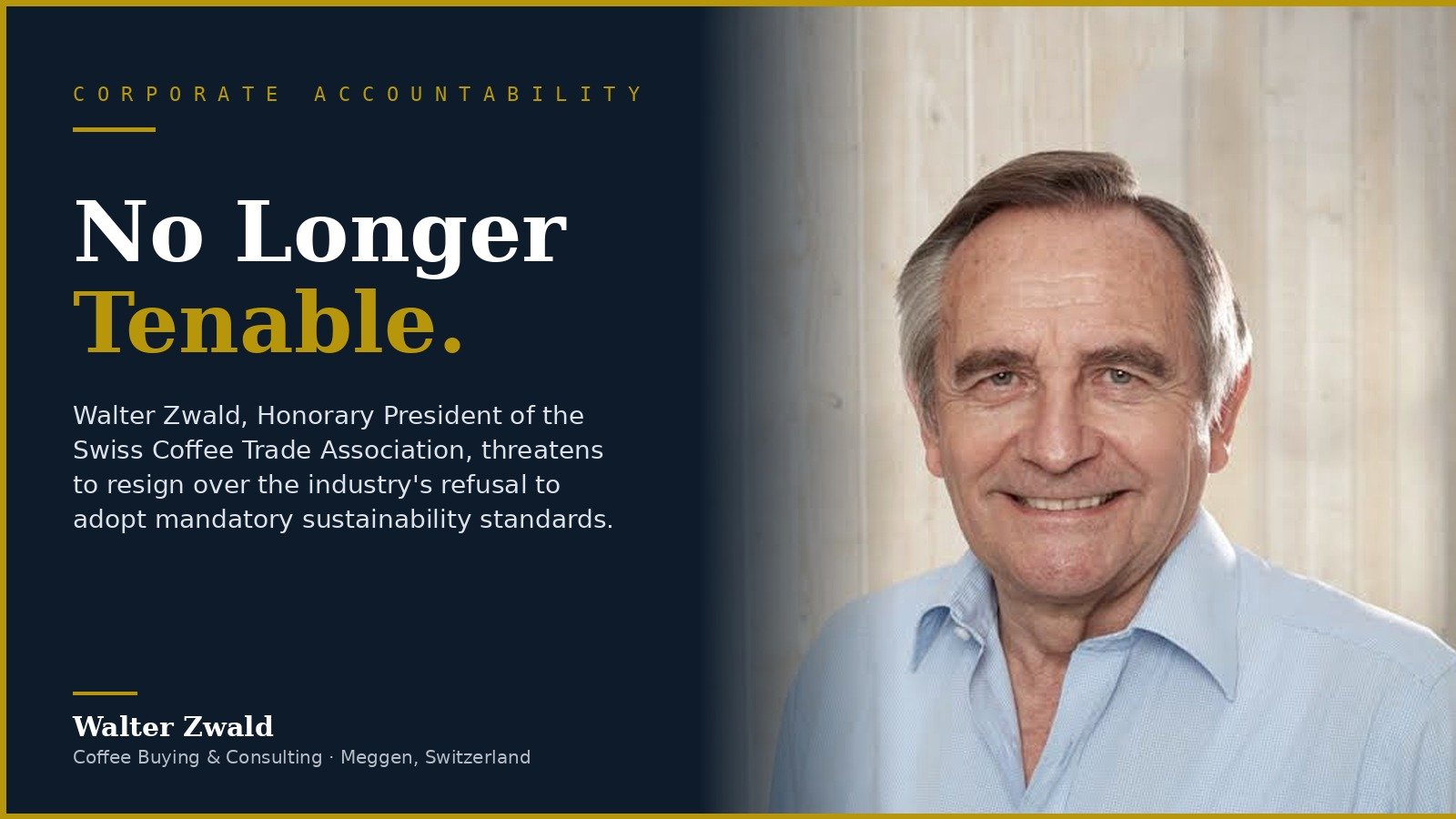
Walter Zwald has spent more than fifty years in the international coffee trade. As Honorary President of the Swiss Coffee Trade Association (SCTA), he has occupied one of the most respected positions in European coffee commerce. On June 3, 2026, he sent a registered letter to the SCTA board that, by industry standards, amounts to an extraordinary act: a threat to resign unless the association adopts binding sustainability rules for its members.
The letter does not mince words. Zwald writes that the coffee sector's structural problems — deforestation, child labor, modern slavery, gender-based violence, poverty wages, and collapsing farmer livelihoods — "can no longer be abstract concerns," and that the SCTA's continued operation "without even the most basic sustainability requirements for membership... is no longer tenable."
He is asking for four specific, enforceable conditions to be applied to all SCTA member companies: no deforestation in supply chains, full traceability to farm level, zero tolerance for child labor, forced labor, and sexual violence with remediation for abuse cases, and binding commitments to a living income price for farmers and living wages for farmworkers.
Zwald frames this as a structural market failure rather than a simple ethics problem. Companies that pay fairly, verify their supply chains, and refuse to source from abusive operations absorb real costs that their less scrupulous competitors do not. "This creates a race to the bottom," he writes, "where responsible companies are penalized for their ethics, and unethical ones are rewarded for harmful shortcuts." Without industry-wide minimum standards, he argues, doing the right thing remains a competitive disadvantage rather than a baseline expectation.
The letter gave the SCTA board a one-month window before Zwald said he would take the matter to NGOs, media, and "concerned authorities" — copying the German Coffee Association, Coffee Watch founder Etelle Higonnet, and a senior Nestlé public affairs executive on the original letter.
A Named Test Case: Nestlé and Neumann Kaffee Gruppe
In a follow-up document, Zwald moves from general principle to a specific, named example. He describes a meeting on April 13, 2026, with Nestlé's Head of Global Public Affairs, in which he says he was told that Nestlé is not prepared to stop purchasing green coffee from companies within the Neumann Kaffee Gruppe (NKG).
This matters because NKG's Kaweri Coffee Plantation in Uganda has an extended, unresolved legal history. Roughly 4,000 people were evicted from four villages in Mubende District in August 2001, an eviction the plaintiffs say was carried out by the Ugandan army to clear land for the plantation.
A 2013 ruling held Kaweri Coffee Plantation Ltd. and the Ugandan government jointly liable for compensation. A partial consent judgment was sealed in Kampala's High Court in February 2022, setting compensation of roughly 2.58 billion Ugandan shillings plus 150 million shillings in costs for 258 of the original plaintiffs, payable by June 30, 2022. According to a 2026 appeal letter from the human rights organization FIAN, that payment still has not been made, and the remaining evictees who did not settle continue to wait without any resolution at all.
Zwald's position is that as long as a named buyer in this case continues sourcing from NKG without resolution of the outstanding obligations, downstream brands cannot credibly claim ethically sound supply chains. He names Starbucks, Aldi, Lidl, and Tchibo as other companies he understands continue to buy from Neumann sources, based on statements he says NKG itself has made.
Other Threads Raised
The same document raises a series of additional concerns that go beyond the Uganda case:
The treatment of Yasmine Motarjemi, Nestlé's former head of food safety and quality management, who won a long-running mobbing case against the company before the Cantonal Court of Vaud. Zwald argues that had her warnings been acted on at the time, problems later identified in Nestlé's baby food and mineral water lines might have surfaced sooner.
The EU Deforestation Regulation (EUDR), which Zwald argues should be shaped by people with practical coffee production experience rather than civil servants, and which he says should apply uniformly to all companies handling coffee and cocoa rather than exempting smaller operators below the regulation's 1,000-employee threshold.
The conduct of trade associations themselves. Zwald calls for the leadership of both the German Coffee Association and the SCTA to be replaced, arguing that years of inaction on the Neumann case have damaged the credibility of the sector's representative bodies.
The state-funded Swiss Sustainable Coffee Platform, financed by the State Secretariat for Economic Affairs (SECO) with several million Swiss francs in public money, which Zwald argues represents an inappropriate degree of government involvement in what should be an industry-led process.
Industry Reaction
Coffee Watch founder Etelle Higonnet republished the letter on LinkedIn, where it drew a substantial and largely supportive response from sustainability professionals, supply chain consultants, and producers. Several commenters noted the unusual nature of an industry elder staging a public threat of resignation rather than continuing quietly. Others raised harder questions: who absorbs the cost of traceability and certification if it is mandated, whether smallholder farmers — who produce roughly 60% of the world's coffee — can realistically meet new compliance burdens without dedicated support, and why these standards were not pushed earlier in a fifty-year career with substantial influence over the sector.
As of this writing, the SCTA has not issued a public response.
This story will be updated as developments occur. CoffeeTradeJustice.org will continue to track the response from the SCTA, Nestlé, and the Neumann Kaffee Gruppe.
Documents
Related Stories
Aug 26, 2026
Hamburg Coffee Traders in Turmoil: Benecke Coffee Insolvency Highlights Darboven Family Ties Amid a Decades-Old Unresolved Dispute
A traditional Hamburg coffee wholesaler with 14 qualified staff and a recent profit has entered insolvency proceedings — yet the story runs …
Jun 24, 2026
Bitter Truth Behind Sweet Enjoyment. Neumann Kaffee Gruppe (NKG) grabbing land in Uganda.
Coffee and Chocolate as Products of Exploitation – Companies Profit from the Inactivity of Governments, Authorities, and Associations in Swi…
Jun 24, 2026
JJ Darboven Hamburg & JJ Darboven Poland: A Record of Default
Polish Coffee Corporation sp. z o.o. (Gdynia, Poland) is the injured party in this case. This site was established to create a permanent, do…
Know something we don't?
If this story connects to something you've witnessed — reach out. Tips can be submitted anonymously.
Submit a Tip